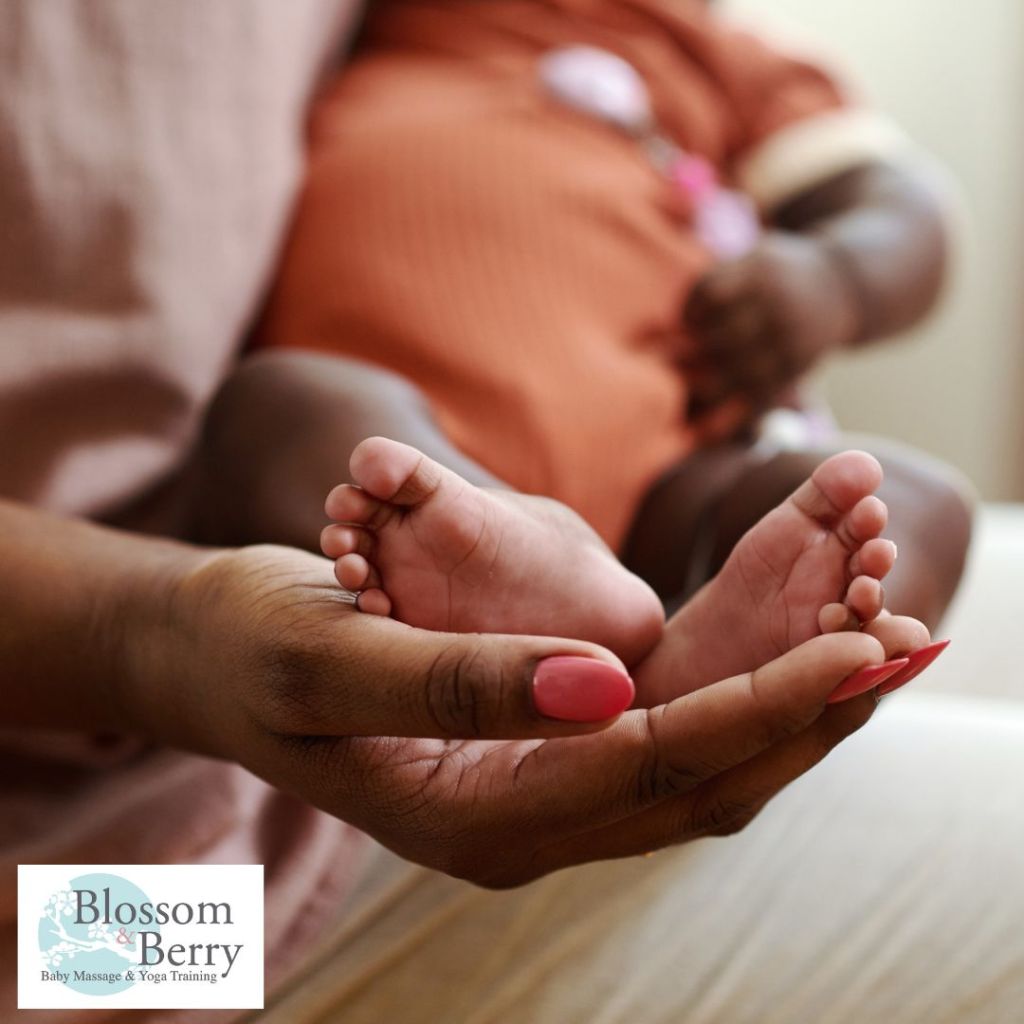
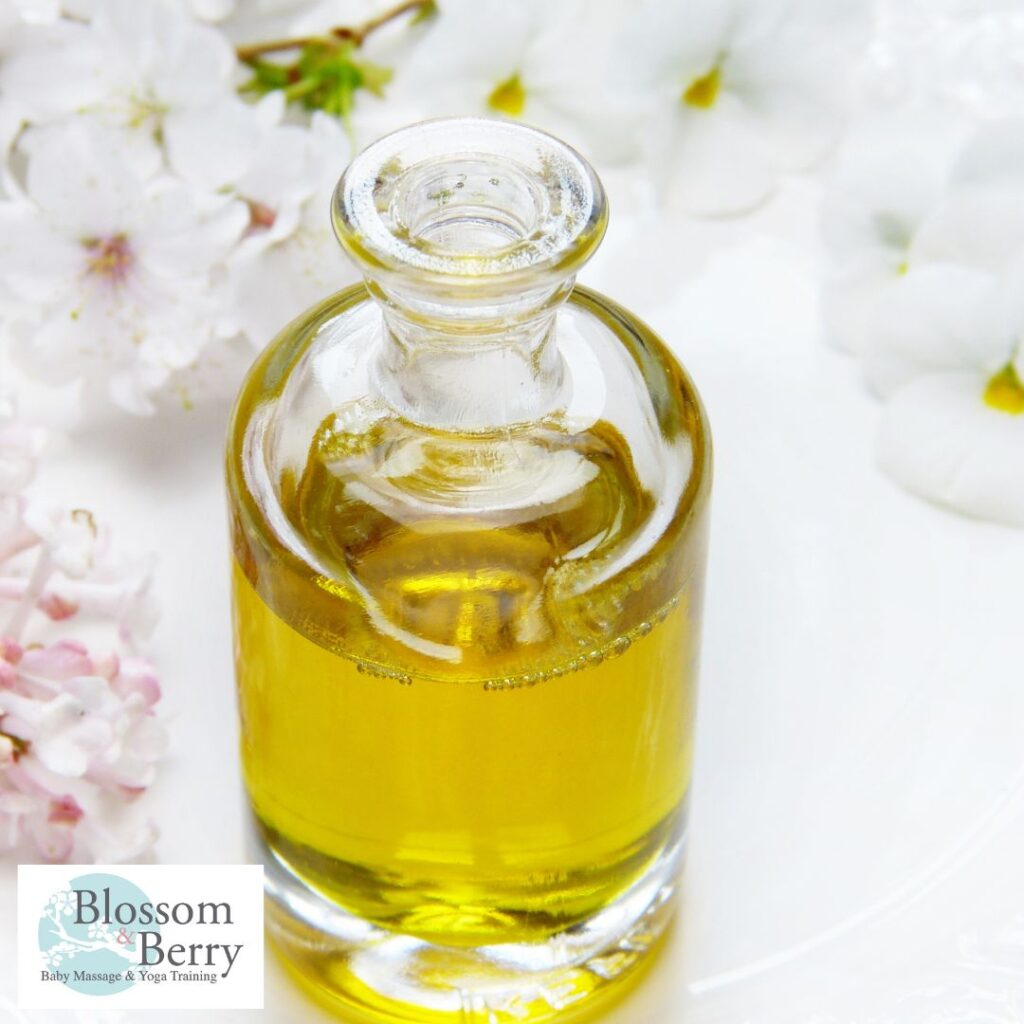

Of all the questions that parents ask me in the first baby massage class, “which oil should I use?” is by far the most popular. It’s invariably asked with a bottle in hand: something from the baby aisle, a jar of coconut oil from the kitchen, or a little bottle of olive oil from a relative who swears by it.
I’ve been teaching baby massage for over 23 years and have been training other instructors through Blossom & Berry for the majority of that time. My answer has evolved over the years as the research has changed. This guide sets out what we now know, what I tell parents in class and the simple checks that make massage both safe and enjoyable for your baby.
Watch: choosing the best oil for baby massage
In this short video I go through the oils I am asked about most, what to look for on the label and how to do a patch test at home.
First, the short answer
For the first few weeks your baby will normally need no oil at all. Plain water for bathing and your warm hands are quite sufficient. Once your baby is a few weeks older and you’re ready to start massage, choose a plain, unperfumed, cold-pressed vegetable oil (no added fragrance, no essential oils), do a patch test first and stop if there’s any redness.
The detail is important here, as some of the oils that families have used for generations aren’t actually the best for very young skin.
Why newborn skin needs extra care
A baby’s skin is thinner than an adult’s and their skin barrier is still developing. Health for Under 5s (the NHS-backed advice service) explains that the skin barrier develops over the first month or so, and takes longer if a baby is born prematurely. Their advice is to bathe in plain water for the first month and to avoid cleansers, lotions and medicated wipes at that stage (Health for Under 5s).
That white, waxy coating some babies are born with (the vernix) is also best left alone. It is a natural moisturiser and helps protect against infection.
What the research says about oils
The study I refer to most in class was led by Alison Cooke, a midwifery lecturer at the University of Manchester. Her team gave 115 babies either olive oil, sunflower oil or no oil, twice a day for four weeks. The babies given oil had slightly more hydrated skin, but both oils also appeared to slow the development of the skin barrier compared with the babies who had no oil at all. The researchers concluded that the two oils should not be recommended for the skin of healthy newborns until further evidence is available (University of Manchester, 2015; published in Acta Dermato-Venereologica).
This was a pilot study, so it’s not the final word. It is, however, the best UK evidence we have on newborn skin and oil, and that’s precisely why I now give parents a much more considered answer than I did 20 years ago.
Common oils compared
Here’s how the oils that parents most often ask about compare. “Newborn” means the first four weeks.
| Oil | Newborn (0 to 4 weeks) | Baby massage after 4 weeks | Things to know |
|---|---|---|---|
| No oil (dry hands or plain water) | Recommended | Fine at any age | Massage works well without oil, especially for short sessions over a vest |
| Olive oil | Avoid | Not recommended | Shown in UK research to weaken the developing skin barrier |
| Sunflower oil | Avoid | Use with care | Same study found barrier effects in newborns; choose cold-pressed and patch test if used later |
| Fractionated coconut oil | Not needed | Often used | Light and non-greasy; little research on babies, so patch test |
| Sweet almond oil | Not needed | Check with your GP first | A nut oil; avoid if there is any family history of nut allergy |
| Grapeseed or jojoba | Not needed | Sometimes used | Light textures; limited baby-specific research |
| Scented baby oils and essential oils | Avoid | Avoid unless advised | Fragrance and essential oils can irritate young skin |
| Mineral baby oil | Not needed | Some parents use it | Petroleum-based; sits on the skin rather than absorbing |
How I help parents choose an oil
When a parent asks me which oil to buy, I ask them three questions first.
- How old is your baby? If under four weeks, I’d suggest leaving the oil out and just doing a few gentle strokes over a vest or on dry skin.
- Any eczema, dry skin or allergies in the family? If so, speak to your health visitor or GP before using any oil, and avoid nut oils.
- What does the label say? Look for a single ingredient, cold-pressed and unrefined, with no fragrance, no colour and no essential oils.
If the answers are all straightforward, a very small amount of a light, unperfumed oil is usually fine for massage from around one month. You need far less than most people think. A few drops warmed between your hands is more than enough for the legs and feet.
How to patch test a new oil
I teach every parent this before they use any new product, and our instructors teach it in every course.
- Rub a single drop onto a small patch of skin on the inside of your baby’s wrist or on the back of the leg.
- Leave it for 24 hours.
- Check for redness, bumps, dryness or any change to the skin.
- If you see anything at all, don’t use that oil and let your health visitor know.
Oils and products to avoid
- Olive oil and mustard oil on the skin of a newborn.
- Anything perfumed, including many products sold as “baby oil”.
- Essential oils such as lavender or chamomile on the skin, unless a health professional has advised you to use them.
- Nut oils if there’s any history of nut allergy in the family.
- Any oil on broken skin, rashes, the umbilical cord stump or near the eyes.
An example from class: from olive oil to dry-hand massage
This is a typical situation we see in our classes. Details have been changed to protect the family’s privacy.
A mother came to one of our classes with her five-week-old. Her family had always used olive oil and she’d been rubbing it in after every bath since he came home. She was concerned because his cheeks and the creases of his arms were quite dry and a little red.
We went through the Manchester research together, and she decided to stop the olive oil and ask her health visitor to look at the dry patches. In class she worked through the leg and foot strokes over his vest with no oil at all. A week later she patch tested a plain fractionated coconut oil (no reaction) and started using a few drops for his evening leg massage.
What really struck her was that the massage itself didn’t depend on the oil. He settled just as well with dry hands, and the routine of a quiet ten minutes before his feed became the part of the day they both looked forward to.
Does baby massage actually need oil at all?
No. Oil just makes the strokes glide more easily over bare skin. The benefits that parents actually notice, such as a calmer baby and more relaxed feeds, come from the touch and the attention, not the bottle. A Cochrane review of infant massage in babies under six months found some evidence of benefit for mother and baby interaction, sleep and crying, and no evidence of harm (Underdown et al., Cochrane Library).
For more on what massage can and can’t do for sleep, read our guide Can baby massage help my baby sleep? You may also like Essential baby massage supplies and The roots of baby massage. If you’d like to learn the full routine with support, our parent classes are run by Blossom & Berry trained instructors all over the UK and online. If you’d like to teach it yourself, our guide to baby massage instructor training explains how to qualify, and our step-by-step guide covers baby yoga instructor training too.
Quick reference: oil safety checklist
| Check | What to do |
|---|---|
| Age under 4 weeks | No oil; plain water for bathing |
| Label | Single ingredient, cold-pressed, unperfumed |
| Family history of nut allergy or eczema | Ask your GP or health visitor first |
| New product | Patch test for 24 hours |
| During massage | A few drops only, warmed in your hands |
| Reaction | Stop and seek advice |
Love learning about baby massage? Turn your passion into a career!
Discover how you can support parents and babies through nurturing touch with our Baby Massage Instructor Training.
Frequently asked questions
When can I start using oil on my baby?
Most UK advice is to wait until your baby is at least four weeks old, and longer if they were born prematurely. Until then, use plain water for bathing, and massage on dry skin or over clothing.
Is coconut oil safe for newborn skin?
There’s very little research into coconut oil and newborns. If you want to use it after the first month, choose fractionated or plain coconut oil with no fragrance and do a patch test first.
Why shouldn’t I use olive oil on my baby?
A University of Manchester study found that olive oil slowed the development of the skin barrier in newborns. Until there is further evidence, it’s best avoided on young babies.
Can I use baby oil from the supermarket?
Many products sold as baby oil are mineral oil with added fragrance. Fragrance can irritate young skin, so check the label and choose an unperfumed one if you use one at all.
What’s the best oil for baby massage if my baby has eczema?
Talk to your GP or health visitor first. They may recommend a prescribed emollient rather than a cooking or cosmetic oil.
How much oil do I use for baby massage?
A few drops warmed between your palms is enough for the legs and feet. If your hands are slippery, you’ve used too much.
Do I need oil for baby massage?
No. Massage on dry skin or over a vest works well and is the best option for newborns.