
Can Baby Massage Help With Tummy Time and Early Movement?
I’ve spent 23 years watching what happens when parents learn to use their hands with intention, not in a mystical way but in a measurable way. Integrating baby massage for tummy time isn’t about bonding alone, though that matters deeply. It’s about building the physical infrastructure your baby needs to move through the world.
When you understand how targeted touch shapes early motor development, tummy time stops being a daily battle and starts being a supportive conversation between you and your child’s body.
The Evidence Is Clear: Touch Builds Movement Capacity
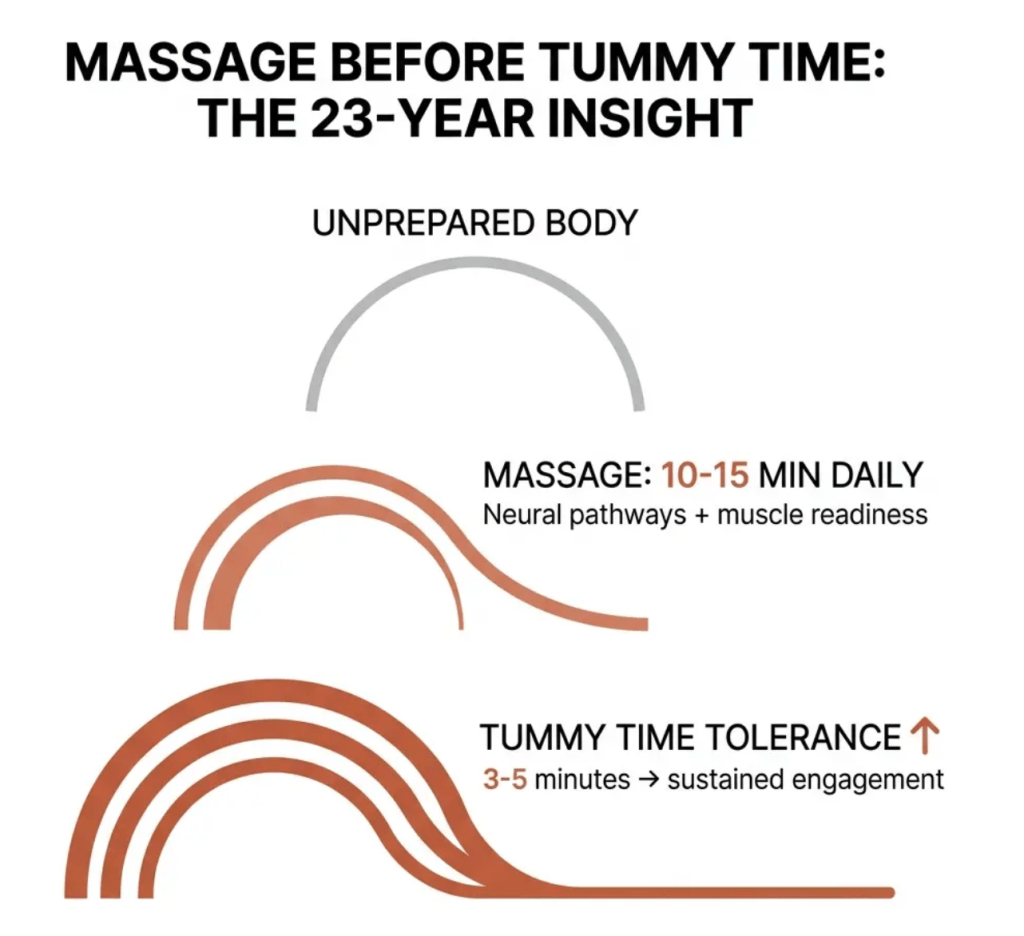
Here’s what recent clinical research shows us. Babies who receive massage 1–2 times daily for 10–15 minutes over the course of one month demonstrate statistically significant motor development improvements. These are not subtle shifts; they are measurable gains in how they move, coordinate, and respond to their environment.
The World Health Organization (WHO) highlights that 30 minutes of daily tummy time creates distinct advantages in gross and fine motor development, problem-solving abilities, and social skills. Babies meeting this daily recommendation reach sitting, crawling, and standing milestones much earlier than those who don’t.
But tummy time doesn’t merely strengthen muscles; it forms neural connections.
When your baby is in a prone position, they actively use their neck and trunk muscles to take in their surroundings. This isn’t just physical exercise. It’s how they form neural pathways in relation to their environment, your communication, and the objects around them.
And structured touch therapy prepares the ground for all of it.
Neurobiology: How Massage Maps Your Baby’s Body
I need you to understand something that most generic parenting advice skips over: your baby doesn’t know where their body ends and the world begins. Not at first.
Tactile stimulation gives infants the opportunity to explore specific tactile and intersensory correlations. Through your touch, they learn how to modulate stimulation through motor commands, like moving a hand to a specific body location while integrating vital tactile and proprioceptive information.
This is exactly how coordinated action develops.
Using baby massage for tummy time preparation creates a precise internal “body map.” Each stroke, each gentle movement of their limbs, and each moment of deliberate pressure adds information about where their body lives in space and how to use it.
Proprioceptive development begins in utero and continues through every kick, reach, and moment of being held. Whether your baby is being massaged, kicking their feet, playing on their tummy, or exploring their face with their hands, they are continuously adding information to this neural map. This is why a massage session prior to floor play changes everything.
The Mechanics of Preparation: Activating the Sensory Systems
When you massage your baby before turning them onto their stomach, you’re not just relaxing them. You are actively priming their physical systems.
Through deep pressure and rhythm, massage stimulates the tactile system and the vagus nerve, which directly improves sensory processing and parasympathetic regulation. This leads to increased motor development, particularly for infants showing signs of sensory sensitivity or under-responsiveness.
Core Muscle Strengthening
Gentle massage along the spine, sides, and abdomen actively prepares the muscle groups your baby needs to lift their head, push up on their forearms, and eventually roll over.
Flexibility Enhancement
Moving your baby’s limbs gently through their natural range of motion during a massage increases flexibility, making the intense physical demands of prone position play far more comfortable.
Sensory Preparation
Massage helps your baby process the intense sensory feeling of textured floor surfaces against their chest and stomach, reducing the sensory overload that makes some babies resist tummy time entirely.
Nervous System Regulation
A calm, regulated baby tolerates prone play significantly longer and engages more fully with the developmental work it requires.
This isn’t just theory. A systematic review demonstrated that consistent baby massage performed twice weekly for 15 minutes over a four-week period has measurable, positive effects on improving growth and structural development. The specificity of the dosage matters. This isn’t about random touch; it’s about structured, consistent intervention.
Case Study: From Daily Struggle to Tolerating the Prone Position
I’ve trained thousands of parents and practitioners across the globe, and those who integrate baby massage for tummy time routines report something highly consistent: floor play stops being a stressful struggle. Not because their baby suddenly loves being on their stomach automatically, but because their baby’s body is physically prepared for the exertion.
I remember a mother in one of our programs who came to me utterly frustrated. Her three-month-old would cry within seconds of being placed on her tummy. She’d tried everything, bright toys, mirrors, getting down on the floor right beside her. Nothing worked.
We adjusted her routine to include five minutes of intentional massage right before each planned tummy time session:
-
Gentle, grounding strokes down the spine.
-
Soft, expanding circles over the shoulders.
-
Light, stabilizing pressure along the arms and legs.
Within a week, her daughter was tolerating tummy time for three full minutes without distress. Within three weeks, she was confidently pushing up on her forearms and looking around the room with calm curiosity. The difference wasn’t motivation or distraction. It was physical, neurological, and sensory readiness.
A Practical Framework for Parents
You don’t need elaborate techniques or expensive, specialised oils. You need consistency and clear intention.
| Element | Recommended Approach | Purpose |
| Timing | Prior to prone floor play | Prepares the muscle groups and sensory systems |
| Duration | 10–15 minutes | Short, focused sensory input without fatigue |
| Frequency | 1–2 times daily | Builds predictable, recurring neural pathways |
| Technique | Gentle, firm pressure | Defines body boundaries (avoid light tickling) |
| Observation | Responsive tracking | Tailoring the speed and pressure to baby’s cues |
You’re not following a rigid script. You’re learning to read your baby’s unique body language and responding to what it tells you.
Beyond Milestones: Building Lasting Lifelong Infrastructure
The motor development gains matter. The earlier milestone achievements matter. The increased physical tolerance for floor play matters. But what matters most is the relational foundation you are building between you and your child.
When utilising baby massage for tummy time, you are teaching your baby that their body is a safe space, that sensation can be deeply pleasant, and that being touched is an intentional form of respectful communication. Simultaneously, you are teaching yourself to slow down, observe, and respond rather than simply direct.
These aren’t soft skills. They are foundational capacities that shape how your child experiences their physical self and the wider world for years to come. The parents I work with often tell me that infant massage completely changed how they view their baby—not as an optimisation project to complete, but as a whole person to deeply know.
That shift matters infinitely more than any generic milestone chart.
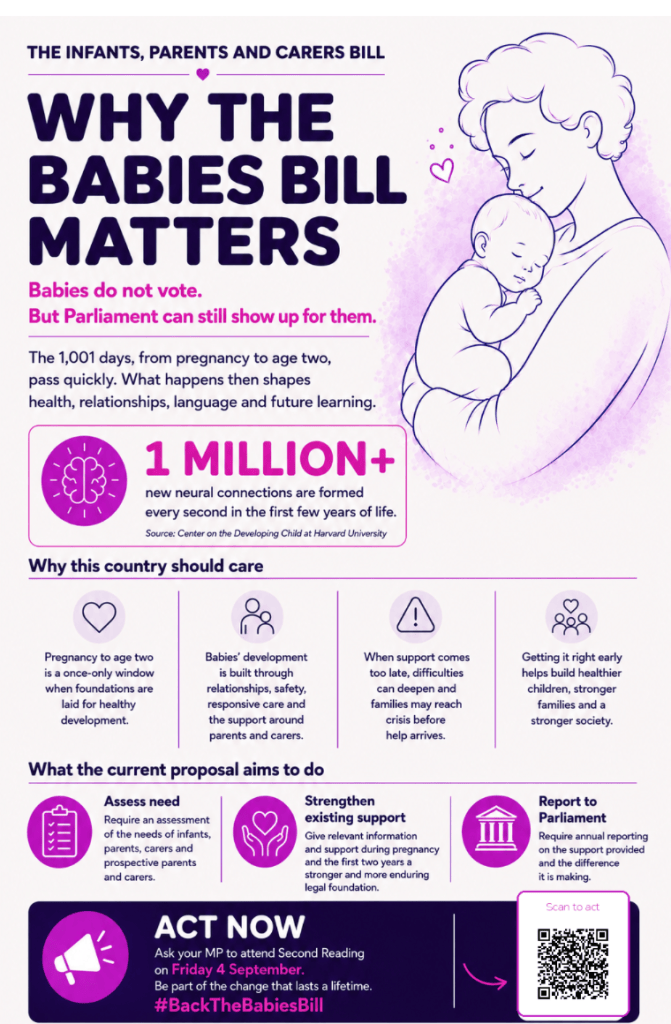
The first 1,001 days of your baby’s life, from conception to age two, are when the foundation of human architecture gets laid down. It encompasses motor skills, sensory processing, emotional regulation, and relational capacity. Massage during this critical window isn’t a trendy add-on. It’s a core building block.
How to Get Started Today
If you are currently struggling with prone floor play, shift your strategy and introduce baby massage for tummy time routines first. If your baby resists being on their stomach, actively prepare their neuromuscular system before changing their position.
You already have everything you need to succeed. The clinical evidence supports it, the neuroscience explains it, and decades of practice prove it. Your baby’s body is learning how to move through the world. Massage is simply how you help them build the clear map they need to navigate it confidently.