
Baby Massage and Motor Development: A Complete Guide
I’ve spent 23 years watching parents discover something that completely changes how they see their baby’s first year. It’s not a product. It’s not a breakthrough programme you buy online.
It’s touch.
Not the casual, fleeting kind. I mean intentional touch, the kind that builds critical infrastructure in your baby’s developing brain and body while you’re simply spending time together.
Many people assume the benefits of baby massage begin and end with relaxation. While calming an infant is wonderful, that is only the surface. Intentional touch is actually about creating the specific neurological conditions that make physical progress and motor growth inevitable.
Why Touch Matters More Than You Think
Your baby’s brain is actively building its own internal architecture right now. Every stroke, every movement and every moment of skin-to-skin contact lays down neural pathways that will determine how they eventually move through their physical world.
Touch doesn’t just support development. It encodes it.
Research consistently shows that tactile sensory activities stimulate neural pathways, enhance infant motor skills and foster deep emotional connections. When you massage your baby, you aren’t just soothing a fussy infant. You are actively stimulating the nervous system’s regulation centre, creating the perfect physiological conditions required for exploration, movement, and learning.
Having trained thousands of parents and practitioners across the globe, I can tell you that the ones who understand this distinction move differently with their babies. They aren’t just performing a mindless routine; they are building foundational capacity.
The Science Behind the Strokes
Let’s look at what clinical research actually tells us about baby massage and motor development:
Measurable Milestone Acceleration
Babies who receive intentional massage 1–2 times daily for just 10–15 minutes show statistically significant improvements in motor development within a single month. This isn’t a marginal shift; it is a measurable acceleration during their most critical developmental window.
Here is exactly what happens beneath your hands during a massage:
-
Vagus Nerve Stimulation: Your touch stimulates the vagus nerve. This directly improves sensory processing and helps your baby’s nervous system regulate its own state. When their system is calm and regulated, they are free to focus energy on learning to reach, roll and crawl.
-
Building Proprioception: Proprioception is your baby’s ability to sense exactly where their body and limbs are in space. Regular massage helps infants develop sharper body awareness, which acts as the physical scaffolding upon which all future motor skills are constructed.
-
Deepening Attachment Security: Close, skin-to-skin contact facilitates your own sensitivity and responsiveness as a parent. It promotes a beautiful reciprocity between you and your baby. This matters immensely because secure attachment is directly associated with superior infant motor development.
Through consistent, intentional touch, love becomes physically structural.
The Infant Motor Skills Timeline
Different stages of early development benefit from slightly different touch approaches. Here is how massage supports your baby’s physical milestones over their first year:
0–3 Months: Building the Foundation
Your newborn is currently learning to lift their head, track moving objects with their eyes, and intentionally bring their hands to their mouth. Massage supports early muscle tone and spatial body awareness.
Focus your attention on gentle, rhythmic strokes. Your baby is learning that their body has physical boundaries, and your touch defines those boundaries in the kindest possible way.
4–6 Months: Developing Control
Rolling, reaching, and purposeful grasping emerge smoothly when the nervous system is ready. Targeted massage accelerates this exact readiness.
Studies show that infants who receive weekly tactile stimulation from 4 to 8 months are significantly more likely to successfully reach targets by 7 months than babies who do not receive this targeted sensory input. Your touch is explicitly teaching their brain what is physically possible.
7–12 Months: Gaining Independence
Sitting, crawling, scooting, and pulling to stand—this is the exciting phase where all that early foundational work pays massive dividends. Babies with highly developed proprioception move through their environment with far more confidence.
Continue your massage practice as a steady part of your routine. At this stage, it isn’t just about motor skills anymore; it’s about regulation, secure connection, and non-verbal communication.
What Parents Often Get Wrong
When it comes to optimising a baby sleep routine or development schedule, I see the same common misunderstandings repeated by well-meaning parents:
-
Thinking it needs to be long: It doesn’t. Ten minutes of deeply focused touch beats thirty minutes of a distracted, hurried routine every single time.
-
Expecting your baby to lie perfectly still: They don’t need to. If they are wriggling, reaching, or rolling away, that is active physical engagement. That is their motor system practicing in real-time. Follow their lead.
-
Believing you need to master complex techniques: Complexity doesn’t matter; consistency does. Simple, rhythmic strokes repeated daily create the robust neural patterns that stick.
-
Viewing massage as separate from development: This is development. You aren’t adding another exhausting chore to your day; you are simply optimising the valuable time you are already spending together.
The First 1,001 Days: A Critical Window
There is a strict neurological reason I have built my entire international practice around this specific timeframe. From conception up until age two, your baby’s brain is more plastic, more receptive, and more capable of rapid change than it will ever be again. In this unique window, simple, everyday interventions yield entirely disproportionate, positive outcomes.
We see this clearly in specialised care: touch interventions for premature infants have been proven to dramatically improve state regulation, reduce hospital stays, and accelerate overall motor development. If structured touch works wonders for babies facing the steepest developmental challenges, imagine the structural benefits it offers for typically developing infants.
This developmental window does not stay open forever. I don’t say this to induce parenting pressure; I say it because you hold far more power than you realise. The ordinary, routine moments—nappy changes, post-bath time, quiet mornings—are the exact slots where lifelong development happens.
Beyond Motor Skills: The Bigger Picture
The babies who receive regular, daily massage don’t just move better through the world. They regulate their emotions better, they sleep more deeply, and they engage more confidently with their surroundings.
Simultaneously, the parents who practice massage don’t just support physical milestones; they master the art of reading their baby’s subtle cues. They develop profound confidence in their own intuition and create an unshakeable space for connection in a loud world that constantly demands their attention elsewhere.
This is infrastructure. Not for your baby alone, but for your entire relationship.
What You Can Do Today
You don’t need to wait for the perfect moment or flawless medical knowledge to begin.
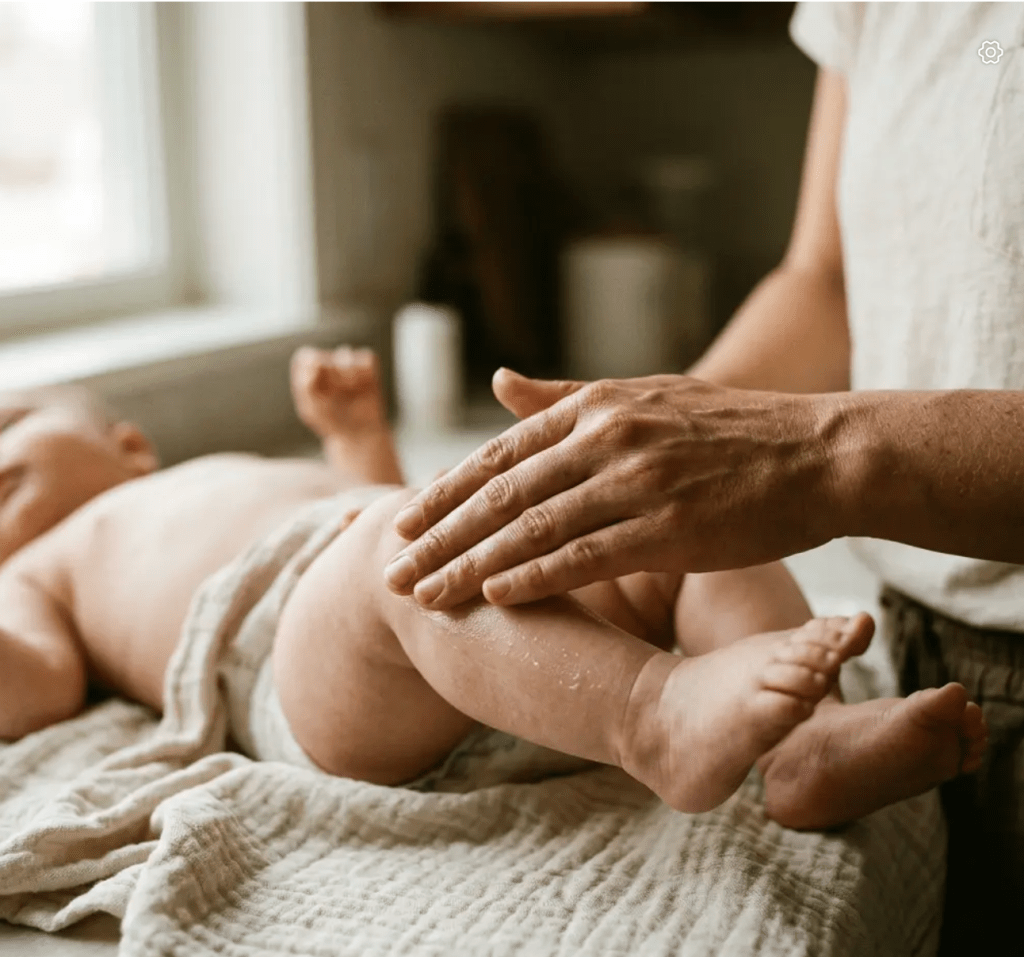
Start tonight. Warm a small amount of natural oil (like coconut, sunflower, or almond) in your hands. Spend ten quiet minutes with your hands on your baby’s body. Notice how they respond, and notice how your own pace slows down. Do it again tomorrow.
That is the entire method. Consistency creates capacity.
Your baby’s motor development isn’t a passive series of events that simply happens to them. It is an active process you get to participate in. Every single touch is a conversation; every stroke is an invitation. You are building the physical and neurological infrastructure that makes their movement through the world confident and inevitable.