
The first 1001 days—from conception through a child’s second birthday—represent a critical window for baby brain development. Understanding how early experiences shape this growth allows us to build a strong foundation for lifelong emotional and cognitive health.
I’ve spent 23 years watching something most people overlook: the way a parent’s hand on their baby’s back changes everything. Not metaphorically. Neurologically.
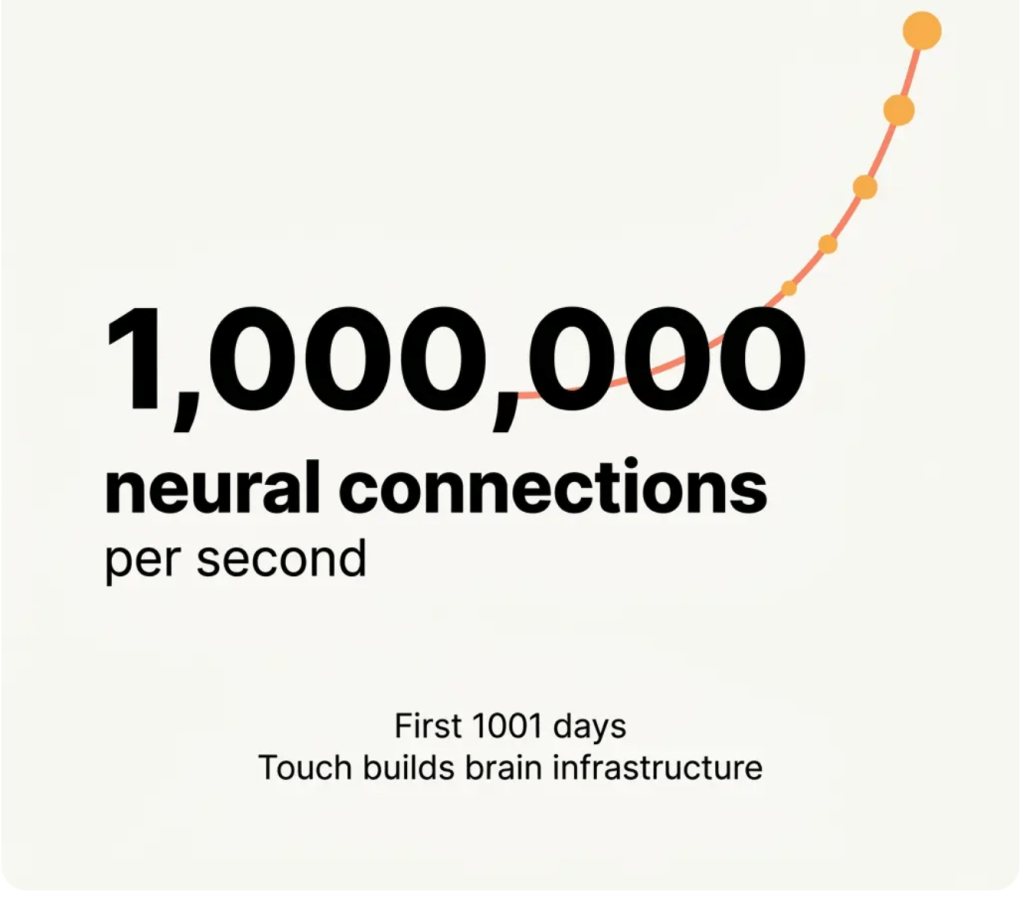
The first 1001 days—from conception through a child’s second birthday—represent the most explosive period of brain development in human life. During this window, a baby’s brain forms more than one million neural connections every second. What I’ve come to understand, through thousands of hours training practitioners and working directly with families, is that touch isn’t simply comforting during this period. It’s architectural.
Touch builds brains. And when we understand how, we can’t unsee the implications.
The Neuroscience We’ve Been Missing
For decades, developmental science focused primarily on cognitive stimulation—language exposure, visual engagement, auditory input. Touch was acknowledged but treated as secondary, a nice-to-have rather than a necessity. The research has now caught up to what practitioners like myself have observed in practice: touch is the primary language of early development.
The skin is the largest sensory organ, and in infancy, it’s the most developed. Before babies can focus their eyes or coordinate their movements, their tactile system is already operational, gathering information about safety, connection, and the world beyond the womb. Every touch sends signals cascading through the developing nervous system, activating regions responsible for emotional regulation, stress response, and social cognition.
Studies using functional MRI have shown that gentle, nurturing touch activates the orbitofrontal cortex and the anterior cingulate cortex—regions critical for emotional processing and empathy. When touch is absent or inconsistent, these areas show reduced activation and, over time, structural differences. This isn’t about correlation. It’s causation, mapped in real time.
What struck me most powerfully in reviewing this research wasn’t just the presence of effect—it was the permanence. The neural pathways formed during the first 1001 days create the template for how a child will process sensation, manage stress, and build relationships for the rest of their lives. Touch doesn’t just soothe a crying baby. It programs the system that will determine how that child—and eventually that adult—navigates the world.
What Happens When Touch Is Present
I’ve trained thousands of practitioners across six continents, and one pattern emerges consistently: families who integrate regular, intentional touch into their routines report measurable changes within weeks. Babies sleep more predictably. Crying decreases. Feeding becomes smoother. Parents describe feeling more confident, more connected.
The mechanisms behind these observations are well-documented. Touch stimulates the vagus nerve, the primary nerve of the parasympathetic nervous system, which governs the body’s rest-and-digest response. When activated regularly through gentle stroking, infant massage, or sustained skin-to-skin contact, vagal tone improves. Higher vagal tone correlates with better emotional regulation, improved digestion, and enhanced immune function.
Touch also directly influences hormonal systems. Oxytocin—often called the ‘bonding hormone’—is released during physical contact, strengthening the attachment between parent and child whilst simultaneously reducing cortisol, the stress hormone. This dual effect creates a neurochemical environment optimised for growth. Lower cortisol means the body can allocate resources to development rather than survival. Higher oxytocin means the relational circuitry is being wired for connection.
But there’s something deeper here that the data alone doesn’t capture. In my work, I’ve observed that touch doesn’t just regulate a baby’s nervous system—it teaches that regulation is possible. Repeated experiences of dysregulation followed by co-regulation through touch create an internal map: distress is temporary, relief is accessible, safety is real. This becomes the foundation for self-soothing, resilience, and eventually, the capacity to manage complex emotional states independently.
What Happens When Touch Is Absent
The inverse is harder to discuss but essential to understand. Touch deprivation during the first 1001 days doesn’t simply delay development—it alters it.
The Romanian orphanage studies of the 1990s provided some of the most stark evidence. Children raised in institutions with minimal physical contact showed significant delays in physical growth, cognitive development, and social-emotional functioning. Even after adoption into nurturing homes, many continued to show difficulties with attachment, emotional regulation, and stress management well into adolescence and adulthood.
Neuroimaging revealed the structural correlates: reduced grey matter in regions associated with emotional processing, smaller amygdala volumes, and disrupted connectivity between the prefrontal cortex and limbic system. These aren’t deficits that can be easily reversed. The brain’s plasticity is greatest during the first 1001 days precisely because it’s building foundational architecture. What gets built—or doesn’t—during this period shapes everything that follows.
Even in less extreme circumstances, insufficient touch has measurable effects. Premature infants who don’t receive regular skin-to-skin contact show slower weight gain, more irregular sleep patterns, and higher stress reactivity. Full-term babies whose parents are depressed or emotionally unavailable—and therefore less likely to engage in spontaneous affectionate touch—show similar patterns of stress dysregulation.
What concerns me most isn’t the research itself but how rarely this information reaches the people who need it. Parents aren’t told that touch is non-negotiable. Practitioners aren’t trained to assess and support tactile interaction as a primary intervention. We’ve medicalised infant care to the point where the most fundamental, accessible tool for healthy development is treated as optional.
The Cultural Context We’re Navigating
There’s a paradox at the heart of modern parenting: we have more information than ever before, yet less confidence. Parents are inundated with advice, products, and protocols, but many feel disconnected from their own instincts. Touch, which should be the most natural form of interaction, has become fraught with uncertainty.
Some of this stems from legitimate concerns—safe sleep guidelines, fears about ‘spoiling’, cultural norms around independence. But much of it reflects a broader societal shift away from embodied, relational practices towards cognitive, achievement-oriented ones. We talk endlessly about brain development but frame it in terms of educational toys and screen time limits, not physical connection.
In some cultures I work with, the question of whether to touch your baby seems absurd. Skin-to-skin contact, co-sleeping, constant carrying—these are default practices, embedded in how families structure their days. In others, particularly in Western, industrialised contexts, parents ask permission: Is it okay to pick up my baby every time they cry? Am I holding them too much?
The research answers unequivocally: no, you cannot hold a baby too much during the first 1001 days. The nervous system is not designed for independence at this stage. It’s designed for co-regulation, for proximity, for touch. Independence will come, but it must be built on a foundation of secure attachment, and that foundation is formed through consistent, responsive physical contact.
Practical Application: What This Means for Families
Understanding the science is one thing. Translating it into sustainable practice is another. I don’t believe in prescriptive parenting—every family’s circumstances are unique—but certain principles apply universally.
First, prioritise skin-to-skin contact, especially in the early weeks. The benefits are immediate and measurable: improved temperature regulation, more stable heart rate and breathing, better breastfeeding outcomes, and enhanced parent-infant bonding. Even 20 minutes a day makes a difference.
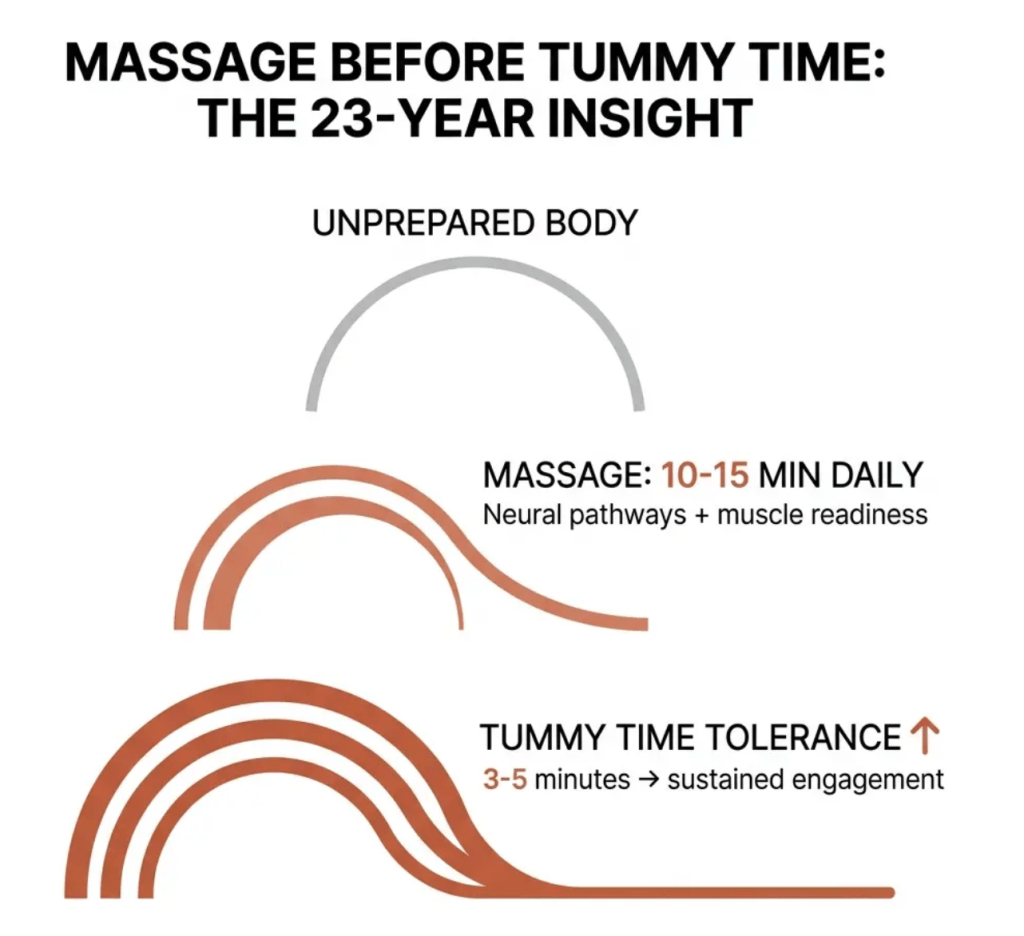
Second, learn infant massage. This isn’t about technique perfection; it’s about creating a daily ritual of intentional touch. The act of massaging your baby stimulates circulation, supports digestion, and provides a structured opportunity for eye contact and communication. More importantly, it builds your confidence as a parent. You learn to read your baby’s cues, to respond to their preferences, to trust your hands.
Third, respond to your baby’s cues for contact. Crying is communication, and in the first 1001 days, it’s almost always a request for proximity. Picking up your baby, holding them, offering physical reassurance—these aren’t indulgences. They’re developmental necessities. The neural pathways for trust and security are being formed in these moments.
Fourth, extend touch beyond infancy. As babies become toddlers, the form of touch evolves, but the need doesn’t disappear. Rough-and-tumble play, bedtime cuddles, sitting close whilst reading—these continue to support emotional regulation and relational connection. The first 1001 days don’t end with a switch being flipped. The patterns established during this period simply become more complex.
The Infrastructure We Need to Build
Individual families can implement these practices, but sustainable change requires systemic support. We need maternity and paternity leave policies that allow parents to be physically present during this critical window. We need postnatal care that includes touch education as standard, not optional. We need practitioner training that equips midwives, health visitors, and early years professionals to assess and support tactile interaction.
Most urgently, we need to reframe how we talk about early development. Touch isn’t ‘soft’ parenting. It’s foundational neuroscience. It’s not about being permissive or indulgent. It’s about recognising what the developing brain requires and creating the conditions for that requirement to be met.
This is infrastructure work. It’s not glamorous, and it doesn’t produce immediate, visible results in the way a new technology or intervention might. But it’s the work that changes trajectories. A child who receives consistent, nurturing touch during the first 1001 days enters school with better emotional regulation, stronger social skills, and greater capacity for learning. That child becomes an adult with lower rates of anxiety and depression, healthier relationships, and greater resilience.
The return on investment isn’t just individual—it’s societal. Every pound spent supporting families to provide responsive, touch-rich care during the first 1001 days saves multiples in later intervention costs. We know this. The research is unambiguous. What’s missing isn’t evidence. It’s will.
What I’ve Learned After 23 Years
I came to this work through practice, not theory. I trained as an infant massage instructor because I wanted to help parents feel more confident. What I discovered was something far more significant: I was teaching a form of intervention that could literally reshape developmental outcomes.
The families I’ve worked with aren’t special. They’re not doing anything extraordinary. They’re simply touching their babies with intention, consistency, and responsiveness. And it works. Not because touch is magic, but because it’s exactly what the developing brain is designed to receive.
What keeps me in this work isn’t the science, though the science matters. It’s watching a parent’s face change when they realise their hands hold power. Not power over their child, but power to support, to soothe, to build something that will last a lifetime. That moment of recognition—that’s the transmission I’m trying to scale.
We can’t afford to keep treating touch as supplementary. The first 1001 days don’t wait for us to catch up. Every day, babies are being born into environments where touch is inconsistent, misunderstood, or absent. Every day, we’re missing the opportunity to build the neural architecture that determines not just individual wellbeing, but collective capacity for connection, empathy, and resilience.
This isn’t about perfection. It’s about priority. Touch doesn’t require expensive equipment or specialised training. It requires presence, intention, and the willingness to recognise that the simplest interventions are often the most profound.
The brain your baby is building right now will be the brain they carry for life. Touch shapes that brain in ways that nothing else can. We have 1001 days to get this right. Let’s use them.