
Every week, in parks and woodlands around the world, Tree Babies Guides spread out blankets, pour the tea, and welcome parents and babies into nature. It looks simple. It is simple. And it turns out there’s serious science underneath it. What looks like a gentle walk in the park is backed by studies covering hundreds of thousands of births.
The scene you already know
A new mother, a few weeks postpartum. The days blur together — feeds, nappies, the same four walls. The washing piles up. The baby stirs and cries, and the crying feels louder indoors than anywhere else. She hasn’t spoken to another adult all day.
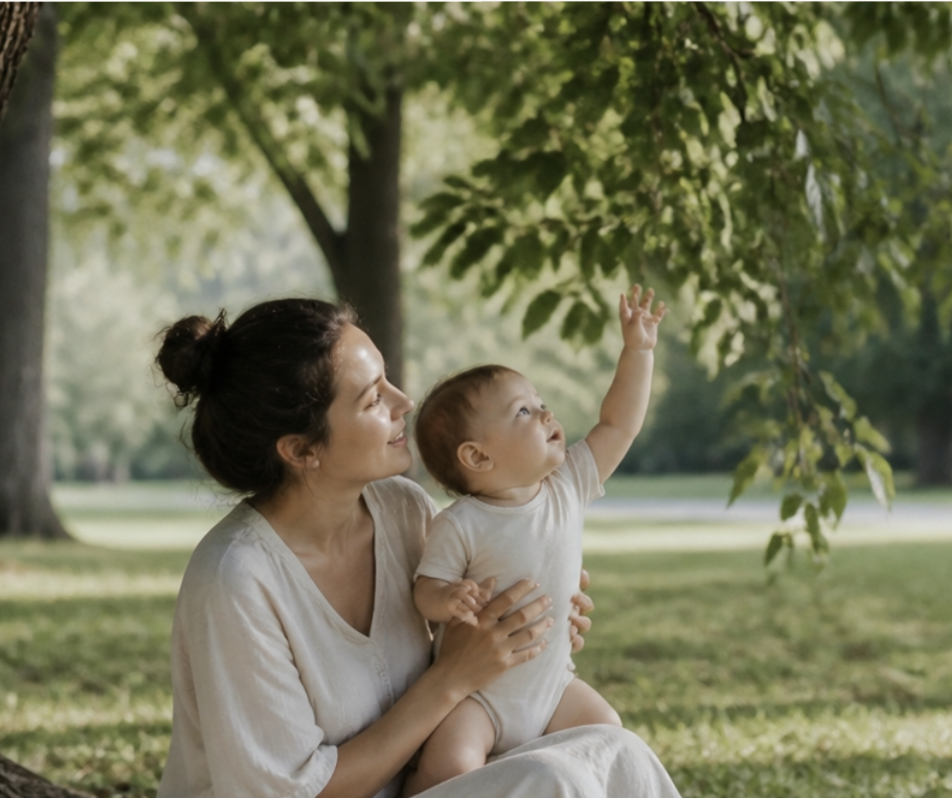
Then she gets outside. She finds a patch of grass, sits down, breathes. The breeze touches her skin. Her baby stops feeding on noise and starts feeding on leaves, sky, light. Another mother sits nearby and says hello.
Ask our Tree Babies Guides and they’ll tell you: they watch this transformation every single week. For a long time, though, “it works because we see it work” wasn’t enough to build a movement on. So what does the research actually say? Quite a lot — and it all points the same way.
Mothers said it first
Researchers at the University of Bristol sat down with 30 mothers of young children — including mothers experiencing postnatal mental health difficulties, refugee mothers, migrant mothers and disabled mothers — and simply asked: what does nature do for you?
The mothers were unanimous. Time outdoors calmed them, lifted their mood, and helped them cope. The fresh air helped one mother breathe through panic attacks: “I found it so much easier to breathe in open spaces.” Sensory time under the sky improved their babies’ sleep — and theirs. And outdoors with their babies, bonding came easily: “I could feel all the oxytocin going through my body holding him.”
“If I’m struggling indoors, or he’s agitated or I’m agitated, the best medicine is to go outside.”— a mother in the Bristol focus groups, 2023
Just as telling were the barriers the mothers named: worrying about the weather, feeling self-conscious feeding outdoors, transport, inaccessible paths, and the sheer mental load of leaving the house with a baby. Nature helps most when someone takes those obstacles away — which is exactly the job of a welcoming, well-organised group.
Then the big data agreed
Feeling better outside is one thing. But could researchers see nature protecting maternal mental health at scale?
In one of the largest studies of its kind, a team analysing 415,020 births in Southern California found that mothers living among more street-level greenery had lower rates of postpartum depression — roughly 4% lower for every 10% more greenery at eye level, with tree cover the strongest protector of all.
And it isn’t one study. A 15-year Australian study of 3,897 women linked greener — and leafier, higher-quality — neighbourhoods to fewer postpartum distress symptoms. A UK cohort found green space helped pregnant women’s mood most where disadvantage was greatest. And a 2025 study in Ghana extended the pattern beyond the wealthy world: greener surroundings, lower maternal stress, anxiety and depression.
Read those together and a quiet truth emerges: access to nature is maternal mental health infrastructure. The benefits concentrate among the families with the least — which is why community sessions matter more than manicured private gardens.
When researchers actually built the programme
Here’s our favourite part of the story — because it’s the closest cousin Tree Babies has.
In Bristol, a research team spent years designing a nature-based programme for postnatal wellbeing the right way round: co-designed with 30 mothers and 15 professionals, not imposed on them. The mothers asked for group sessions, sensory engagement with nature, and real attention to postnatal practicalities. Then the team tested it: five weekly outdoor group sessions, an accredited nature practitioner alongside a peer-support worker, gentle forest-bathing-style invitations, 28 mother-and-baby pairs.
After five weeks:
- Depression scores down 4.3 points (a significant drop)
- Anxiety scores down 4.2 points
- Wellbeing scores up 8.8 points
- 26 of 27 mothers stayed to the end
In the interviews afterwards, mothers described better sleep and confidence, closer bonds with their babies, and — our favourite finding — using nature’s own imagery to make sense of the huge emotional transition of becoming a mother.
If that format sounds familiar, it should. Small groups. A trained, insured guide. Sensory practice in nature. Weekly rhythm. Every family welcomed. It’s the Tree Babies shape — tested and measured.
The deep why: babies are born expecting this
So why would sunshine and birdsong move the needle on something as serious as postpartum depression? Developmental psychologist Darcia Narvaez offers the most beautiful answer in the field: human babies evolved inside a “nest.”
For essentially all of human history, babies grew up with soothing births, near-constant loving touch, responsive care, play, a village of nurturers — and daily immersion in nature. These aren’t luxuries, the research argues; they’re the developmental inputs our biology built its bonding chemistry around — the oxytocin system that underlies trust and connection in parents and babies alike. Early nested care is linked to healthier stress regulation in infancy, and a 2026 longitudinal study showed it flows down generations: well-nested children become the well-nested parents of the future.
That’s a Tree Babies session, item by item
Calming experiences in nature ✓ · positive touch and babywearing ✓ · responsive, unhurried presence ✓ · play and song ✓ · a warm community of other parents ✓. Held in the first 1,001 days — when the brain is built. The evolved nest isn’t an abstract theory to us. It’s the session plan.
What this means for you
Put the three strands together and the conclusion is hard to argue with:
Mothers experience it. Thirty of them described nature as calm, connection and reset in the hardest weeks of their lives. The data measures it. Across hundreds of thousands of births, greener lives mean healthier starts. And a real programme proved it — significant improvements in depression, anxiety and wellbeing, in the very format our guides deliver every week.
When parents and babies slow down together in nature, they’re not escaping modern life. They’re returning to one of its oldest instructions. As our founder Gayle Berry puts it: love creates love — and in our experience, it usually starts outdoors.
Want to hold this space in your community?
This is the work the evidence supports — and we train people to lead it. The Professional Certificate in Nature-Based Parent & Baby Wellness (Tree Babies Guide) is accredited (IICT), insurable worldwide, taught online with live supervision by Gayle Berry, and comes with class plans, business tools and a year of mentorship. Most guides are ready to teach in about six weeks — no franchise fees, ever.
Or share this post with someone who was born to do it.
Sources
- Hall K, et al. Mothers’ accounts of the impact of being in nature on postnatal wellbeing: a focus group study. BMC Women’s Health, 2023.
- Sun Y, et al. Association between urban green space and postpartum depression, and the role of physical activity (415,020 births). Lancet Regional Health – Americas, 2023; summarized by UC Irvine.
- Feng X, Astell-Burt T. Residential green space quantity and quality and postpartum psychological distress (15-year study). BMC Psychiatry, 2018.
- McEachan RRC, et al. Green space and depressive symptoms in pregnant women. J Epidemiol Community Health, 2016.
- Boakye SK, et al. Maternal mental health improvement in Ghana: role of green spaces exposure. BMC Women’s Health, 2025.
- Hall K, et al. Co-designing a nature-based intervention to promote postnatal mental health. BMJ Open, 2023.
- Hall K, et al. The Mother Nature Project: feasibility of a group nature-based intervention for postnatal mental health. SAPC ASM, 2024.
- Armour L, et al. Green space or nature-focused interventions to support parent wellbeing or parent-infant relationships: a scoping review. Wellbeing, Space and Society, 2026.
- Tarsha MS, Narvaez D. The evolved nest, oxytocin functioning, and prosocial development. Frontiers in Psychology, 2023; and evolved nest and cardiac vagal regulation. Early Human Development, 2024.
- Malthouse E, et al. The intergenerational evolved nest. Frontiers in Developmental Psychology, 2026.
- The Evolved Nest: Nine Components Overview — Narvaez D.